Inspirations Behind Kenneth Fuchs’ Autumn Rhythm
American painter Jackson Pollock (1912–1956) was an abstract expressionist painter whose ‘drip’ or ‘poured-paint’ technique signalled a fundamental change in modern painting. Starting in 1947, Pollock’s new style started with a canvas on the floor. Onto this he poured or flung or brushed paint, often house paint, in layers.
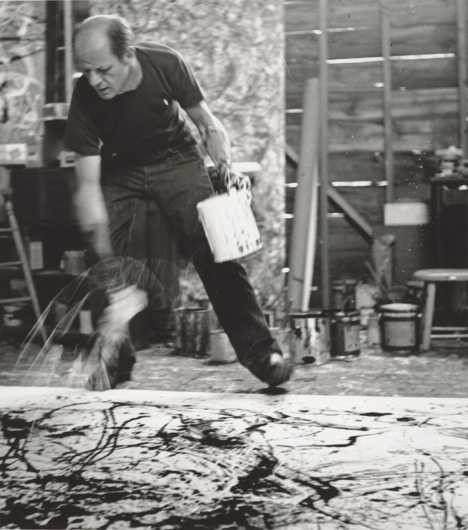
Jackson Pollock, 1950 (Photo by Hans Namuth) (University of Arizona, Center for Creative Photography)
Autumn Rhythm, created in July and August 1950, was part of a documentary by Hans Namuth, who filmed part of the creation of the work. In examining the work from the documentary, viewers see that the piece was created in sections. First, the right third, done with thin black lines, and then adding browns and white and a limited amount of teal blue, then moving on to the centre section and then the left-hand section. After the thin black lines, the additional paint was dripped and poured onto the canvas, creating lines and puddled sections. One of the advantages of placing the canvas on the ground was that it could be approached from any of the four sides.
The work was created over two days in his studio in Springs, New York. In his drips and pours, Pollock noted that ‘the brush doesn’t touch the canvas’ but was used to propel the paint onto the canvas. The work is monumental in size, 8 ft. 9 in. by 17 ft. 3 in. (266.7 by 525.8 cm).
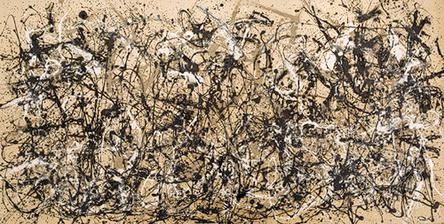
Pollock: Autumn Rhythm (Number 30), 1950 (Metropolitan Museum of Art)
On its original exhibition at the Betty Parsons Gallery in 1950, the work was originally entitled Number 30 as Pollock did not want to give implied meanings to his works that might distract viewers. When it was exhibited in 1955 at the Sidney Janis Gallery, Pollock had given it the title Autumn Rhythm. The Met Museum, which bought the painting in 1957 after the artist’s death, suggests that the title reflects ‘not only the month in which he painted it (October) but also an alignment with nature’s constant flux’.
Described as an Idyll for Woodwind Quintet After a Painting by Jackson Pollock, Autumn Rhythm by American composer Kenneth Fuchs was completed in May 2006, on a commission by the University of Miami School of Music and had its premiere at the Maurice Gusman Concert Hall, Coral Gables, FL, on September 17, 2006.
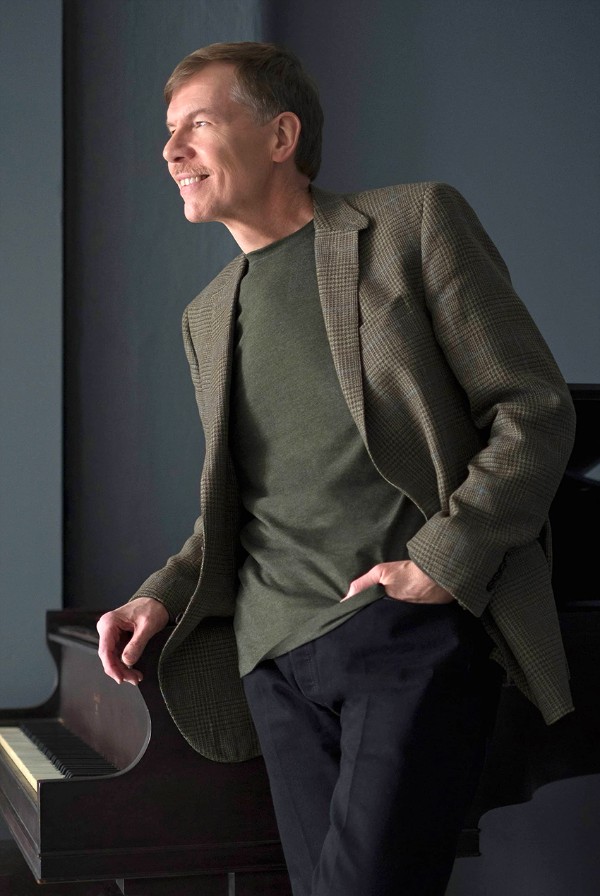
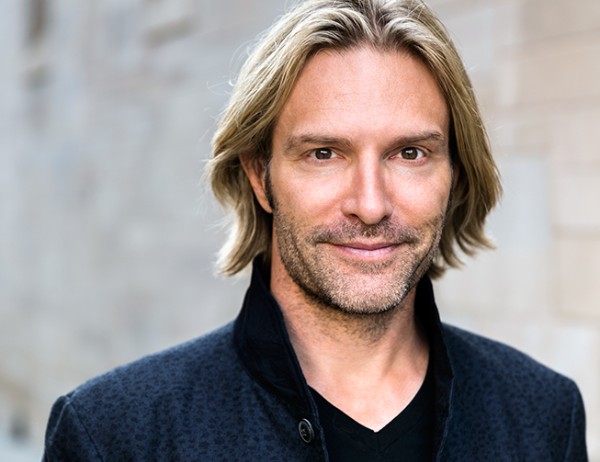
Kenneth Fuchs (photo by Dario Acosta)
Fuchs begins with the intervals of a minor second, minor third, perfect fifth, and a minor seventh. He then goes on to use those 4 intervals, and their inversions form the basis for the melodic and harmonic combinations through the rest of the piece. The opening tempo of Moderato speeds up in the Allegro middle section before the closing section, Larghetto. As a way of showing the way that Autumn is the transition from bright summer to a darker season, the instruments used in the opening (flute, oboe, and clarinet) are gradually replaced by their lower-voiced counterparts (alto flute, cor anglais, and bass clarinet) at the end of the piece.
The work is dedicated to the composer’s first composition teacher, Alfred Reed (1921–2005), who had a distinguished career as an American neoclassical composer and conductor. Fuchs said about the piece and his teacher, ‘It occurred to me that a work for winds inspired by a season in which many of nature’s living elements recede to the earth would be an appropriate tribute to him’.
Kenneth Fuchs: Autumn Rhythm (After a Painting by J. Pollock) (original version) (Gareth Davies, flute; Keiron Moore, oboe; Christine Pendrill, cor anglais; Andrew Marriner, clarinet; John Stenhouse, bass clarinet; Robert Bourton, bassoon; Timothy Jones, horn)
There are many parallels between the piece and Pollock’s formation of his painting: the division into thirds, the gradual laying on of sounds and textures, and, finally, the creation of a work that in its own way redefines the woodwind quintet through lines and harmonics.
For more of the best in classical music, sign up for our E-Newsletter