Inspirations Behind Daníel Bjarnason’s Over Light Earth
Two mid-20th-century abstract impressionist paintings were the source of inspiration for Icelandic composer Daníel Bjarnason. Mark Rothko’s 1954 painting No. 9 (Dark over Light Earth/Violet and Yellow in Rose) and Jackson Pollock’s groundbreaking 1949 painting Number 1, 1949 were seen as works that brought the ‘practical actions of the artist on his canvas (Pollock’s drips and swirls, Rothko’s thick, uneven brushstrokes) into the creation of works that hold a strong grip on our imaginations.’
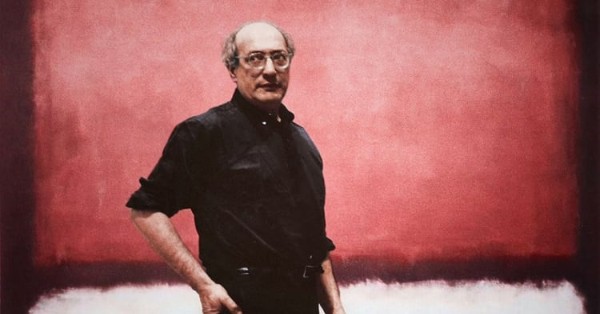
Mark Rothko
Rothko’s colour field painting uses only three colours: a light rectangle at the bottom, a smaller, darker rectangle at the top, over a medium background. These aren’t the lines of Kandinsky or Mondrian; these are rectangles. However, they aren’t clearly defined, their edges waver and even their colour is unevenly presented, with shades and colours behind them showing through. Are the rectangles coming into being or dissolving?
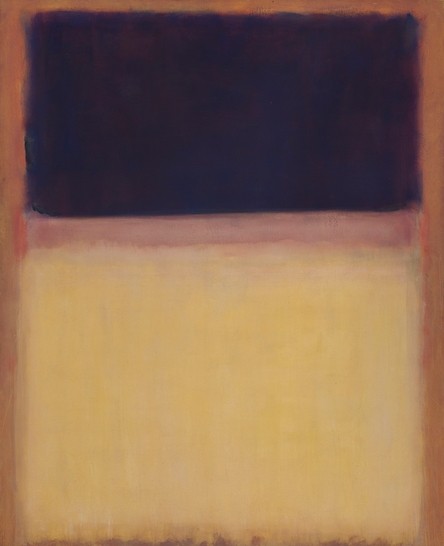
Rothko: No. 9 (Dark over Light Earth/Violet and Yellow in Rose), 1954 (Los Angeles: Museum of Contemporary Art)
The painting is enormous: 83 1/4 x 68 in (211.46 x 172.72 cm). At over 7 feet tall, it confronts the viewer directly.
Rothko was seeking to convey depth and emotion through colour and its application rather than through more representational imagery. Rather than looking at the painting from a distance, the viewer is urged by Rothko to stand just a foot (30 cm) away to get the full emotional impact. According to Rothko, the emotion in the painting caused some viewers to break down in tears.
Daníel Bjarnason (b. 1979) wrote Over Light Earth (2012) as a commission from the Los Angeles Philharmonic Association. He chooses to start at one of the rectangles’ blurred edges and emphasises the edges of the rectangles by placing two grand pianos at opposite ends of his ensemble. Gradually, the field of colour emerges from the high repeated notes only to fade away again, leaving only an oboe melody to close.

Daníel Bjarnason
Daníel Bjarnason: Over Light Earth – I. Over Light Earth (Aarhus Symphony Orchestra; Daníel Bjarnason, cond.)
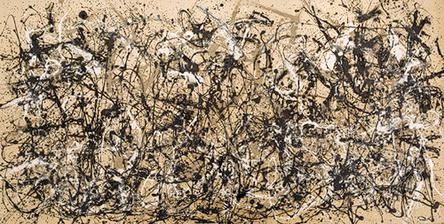
The second movement is based on Jackson Pollock’s first drip painting from 1949. Putting his unstretched canvas on the floor, he poured paint and spattered it from the tips of sticks, achieving the lines and dots of the image. He didn’t use the artist’s traditional tools of easel, palette, and brush, but applied paint directly. He didn’t use high-quality oil paints in little tubes, but house and industrial paint straight from the can. By working vertically, he did away with the idea of a focal point and, instead, uses the lines and colours to lead the viewer’s eye through webs of non-design.
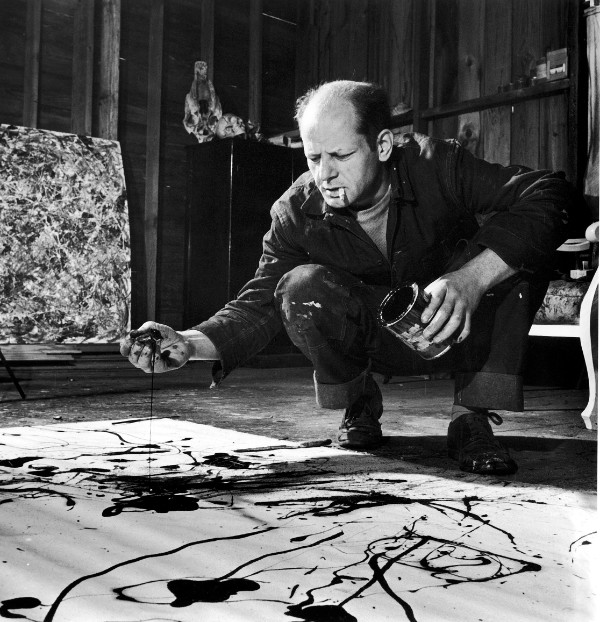
Jackson Pollock working in his studio
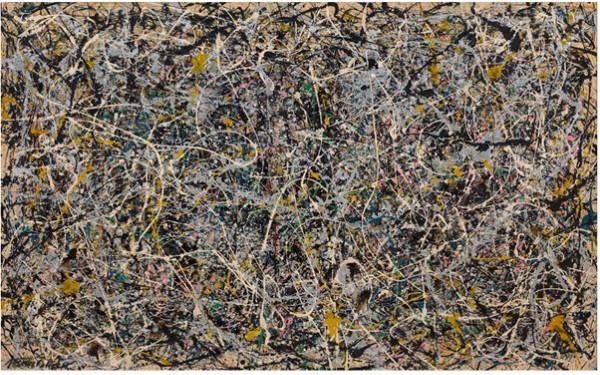
Pollock: Number 1, 1949, 1949 (Los Angeles: Museum of Contemporary Art)
This is another large work, measuring 63 x 102 1/2 in. (160.02 x 260.35 cm) in its final framing.
Bjarnason’s second movement seems to pick up the dripping and throwing quality of the paint line. Depicting Pollock’s dense web of colours (black, yellow, grey and cream with traces of blood red, dark green, lurid pink and more), the music starts with Bjarnason literally throwing the listener into the middle of the painting. Gradually, he pulls in the focus until we are in the spaces between the splatters, standing where the artist stood in the middle of the noise around him. At the end, however, the composer pulls us out of the painting and back to our position in front of it, pondering the multiplexity of the details.
Daníel Bjarnason: Over Light Earth – II. Number 1, 1949 (Aarhus Symphony Orchestra; Daníel Bjarnason, cond.)
The concepts in the works of art are difficult to grasp, even some 70 years later. In imagining the musical world inside the works, in Rothko’s case by looking at the painting through a horizontal plane rather than the vertical, and in Pollock’s case by drilling deeper and deeper into the painting until we are at the point of no paint, Bjarnason is successful in getting the music to help us see the paintings in a very different way. Abstract Expressionism is difficult, and Bjarnason gives us a way to understand it through melody and rhythm, sound and silence, that matches the complexities of the originals.
For more of the best in classical music, sign up for our E-Newsletter