Inspirations Behind Byron Adams’ Midsummer Music
American artist Thomas Wilmer Dewing (1851–1938), working at the turn of the 20th century, was known for his figure paintings of American women. Focusing on the aristocratic women, he evoked a dream-like world for them to inhabit. The women, fashionably dressed, were frequently shown in forest settings, playing musical instruments, dancing, or in conversation with each other.
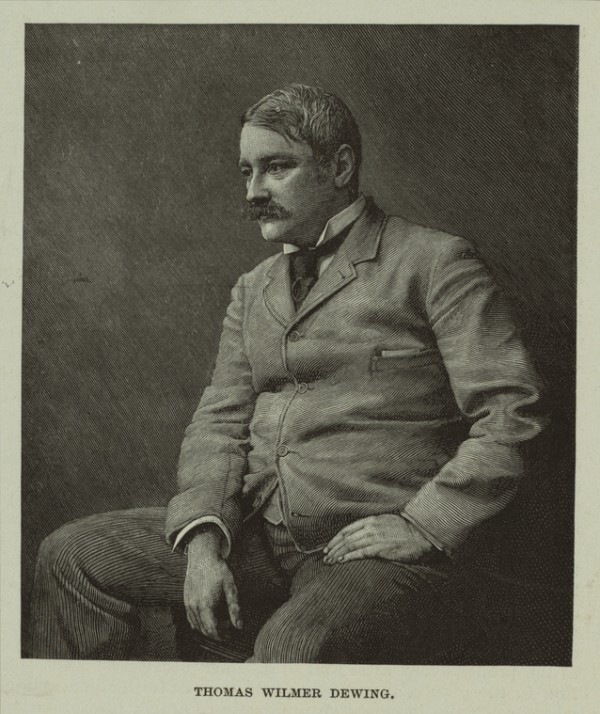
Thomas Wilmer Dewing
Dewing is described as a Tonalist, an American style that started in the 1880s but was eclipsed by Impressionism. Tonalism was used for landscapes, where there would be an overall ‘tone’ of coloured atmosphere or mist.
James McNeill Whistler’s Nocturne in Black and Gold: The Falling Rocket of 1875 is a prime example of this purely American style.
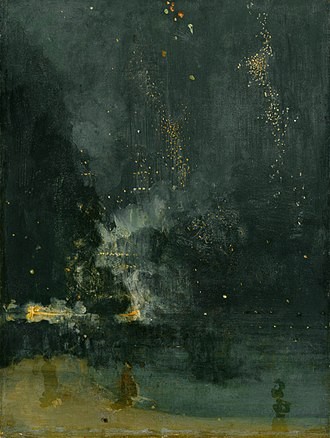
James McNeill Whistler: Nocturne in Black and Gold: The Falling Rocket, ca 1895 (Detroit Institute of Arts)
Tonalism, with its emphasis on an overall colour, stressed mood and shadow. Dewing thought that the purpose of an artist was to ‘see beautifully’ and in his picture, Summer, from 1890, he takes us to five women in the woods.
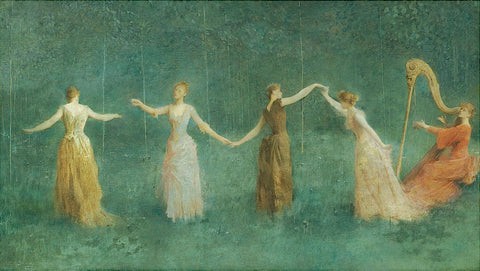
Dewing: Summer, 1890 (Yale University Art Gallery)
The four women, dressed in muted colours of gold, rose, brown, and pink, are dancing to the music of a harp, played by a woman in a red-orange dress. They are in evening wear from the 1890s. Day wear emphasised high necklines and puffed sleeves, whereas evening wear was often bare-armed with an emphasis on a small waist. An open neckline, a floor-length, A-line skirt, with a pointed waistline and back lacing were some of the characteristics. In addition, gathers at the back of the waist and the use of a small bustle emphasised the waistline. The dancers are shown in 4 views: back, front, right side, and left side.
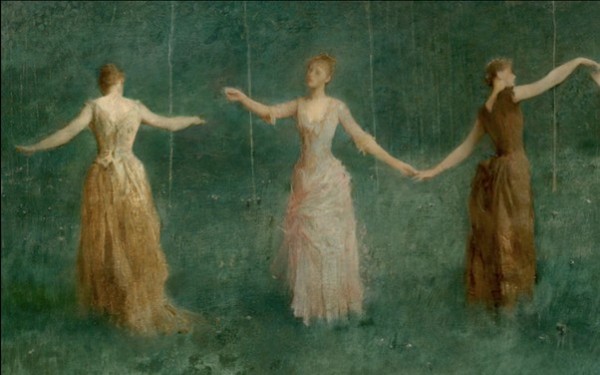
Dewing: Summer, Detail of 3 dancers, 1890 (Yale University Art Gallery)
Behind the dancers, the forest glows green with the white of young birch trees seeming to imitate the women’s poses. The colours of the dresses stand out against the tonal green background, and even though the colours are muted, they are still distinct.
American composer Byron Adams (b. 1955) wrote his impressionistic piece to match the painting. The composer cited Dewing’s painting as inspiration for his music. In his 1998 piece Midsummer Music, he has captured the diaphanous quality of the gowns, with the harp always as the background. In the middle of the piece, Adams quotes his music, the song Green, setting a text by D.H. Lawrence, written for voice and harp, and a French melody from the 16th century, Il était une Bergère, telling the tale of an amorous young shepherdess, her cat, and a lascivious priest. At the end, we return to the original impressionist world and a kind of contemplation with birdsong. The final word is with the harp.

Byron Adams, 2017
Byron Adams: Midsummer Music (Royal Philharmonic Orchestra; Michael Poll, cond.)
If Dewing made art so he could better see beauty, Adams has given us a piece that matches it. Matching Dewing’s tonalism, Adams has given us a piece of tonal music
For more of the best in classical music, sign up for our E-Newsletter