Composition as a ‘Two-Way Street’
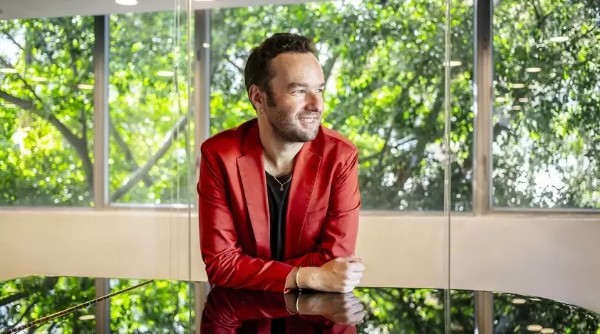
Eugene Birman © hkbu.edu.hk
“High drama” and “intense emotion” (BBC), “magnificent and compelling” (OPERA magazine), “the most stunning and divisive” (Business Times): the music of Eugene Birman frequently stretches the boundaries of cross-disciplinary collaboration, offering up unexpected, novel, thought-provoking ways of how contemporary music can engage, delight, and challenge us.
Born in Russia and moving to the US aged 6, Eugene now splits his time between the US, UK, and Hong Kong, active across three continents and adopting a highly collaborative approach to his work, whether it be fashioning a requiem out of fragments of Russian street interviews in his 2020 work Russia: Today or pushing the boundaries of technological integration into classical music with 3D holographic projections of a virtual choir in Os dias mais longos e os mais curtos [The Longest and Shortest Days] from 2022.
Os dias mais longos e os mais curtos (2022) official trailer
The main thrust of my conversation with Eugene concerns his work En Virtu de… [In Virtue Of…], a piece for solo baritone and small ensemble of three players. The work, only using text from the European Convention on Human Rights, premiered at the Grand Théâtre de Luxembourg in 2022 and, following a revival in Luxembourg earlier this year, travels to Geneva this month for a run at the UN Palais des Nations – a fitting setting given the subject matter of the piece: a political monologue delivered by just one singer, Brazilian baritone Michel de Souza.
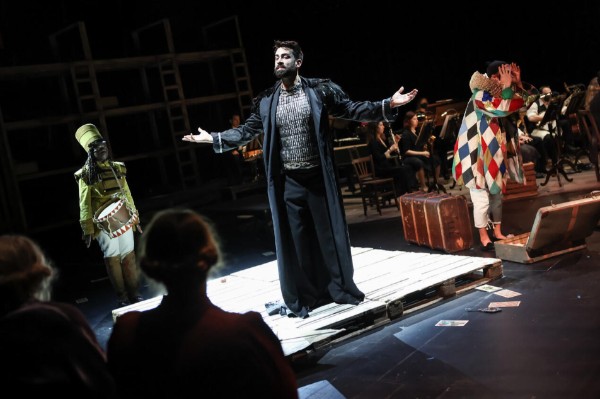
The Emperor of Atlantis © gtg.ch
The performance of En Virtu de… in Geneva forms the first half of an ‘operatic diptych’: at the close of Eugene’s piece, the audience decamps to the Comédie de Genève for a performance of Viktor Ullmann’s chamber opera The Emperor of Atlantis to close out the evening. The seemingly level-headed politician at the opening of En Virtu de… ends up the tyrant in The Emperor of Atlantis, a piece that was conceived by Ullmann along with librettist Peter Kien while interned in a Nazi concentration camp in 1943.
En Virtu de… was born out of a collaboration between Eugene and Belgian-Luxembourgish director Stéphane Ghislain Roussel. I also chat to Stéphane here, who tells me about the work’s germination and the excitement of the rehearsal process.
Does it feel different hearing En Virtu de… now, given what’s going on in the world, compared with when it was premiered in 2022?
EB: I think the project is quite unusual in that it’s a diptych, and it combines a Viktor Ullmann work with a new piece.
When you go back and look at what brings these two very different works together, there is a lot of proximity in the source material. In a way, the European Convention of Human Rights and the European Union were direct reactions, in many ways, to World War Two and the holocaust. Politically speaking, I think the questions [of the past] have not been resolved.
In fact, the EU is somehow stronger in a way, in an ideal sense, but in other ways it’s not, and so from my point of view what makes this very special is the fact that my work happens inside a space where these discussions were had (at the United Nations headquarters in Geneva), so we’re not asking the question in a theatre where it’s very clear that it’s artifice.
How does it feel knowing the piece isn’t being performed in a theatre, but rather in a functional, political space?
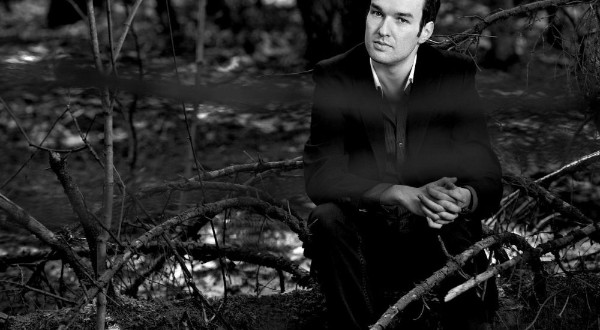
Eugene Birman © eestimuusikapaevad.ee
EB: What I realise, seeing it now compared to before, is that the piece is really not theatre, I think. It’s just reality. I don’t know if that’s the product of time or just the product of some staging, but it just feels like it’s not going to see a theatre work anymore.
You don’t get a programme booklet about the show. You get the articles of the Declaration of Human Rights, and there’s no ‘curtain’. It’s not really meant to feel like a show, and I see that now compared to four years ago, and I realise that in fact if you watch all the speeches of the Munich Security Conference or Davos or whatever, to me that’s more theatrical than what we are doing.
Was this performative element of politics at the forefront of your mind when conceiving the work?
SGR: What I was quite interested in is that the libretto is a very ‘cold’ material. It’s mostly law articles, but in a strange way, the fact that it’s so cold leads to something that’s so warm when you perform it. There is a kind of counterpoint which is quite tense. It’s not balanced. This was something very exciting.
When the final score was there, and we rehearsed with Michel, it was clear that there was something extremely performative in the music itself. It was almost like a kind of very exciting labyrinth of what kind of interpretation you can give, but a labyrinth where you always have the corridor lit up.
EB: Politicians train their whole lives to be performers. In this show, the idea is that we’re lifting a curtain from that. We put on the stage, on the lectern, an idea of what happens when a politician loses his sense, his values, his idealism. In a public setting, of course, people work very hard to preserve the image, no matter what’s going on underneath; here, we show what’s going on underneath. I think it’s somehow more human.
The strange thing is that, of course, there’s music, and there’s singing, and it’s sort of operatic, but as an audience member, you start to not really perceive it as opera or theatre. It just feels like a performance of a speech that goes very wrong.
You both do lots of interdisciplinary collaboration across your careers. In these situations, where do you feel like your ‘contribution’ to the work ends and others’ begins?
EB: What helped a lot was just speaking to Michel de Souza, the baritone for whom this part was really written. If you think about it, a speech should be a very personal thing. It’s a delivery from, it’s something that can only really be read by the person giving it, so in a way, the music should be the music of Michel as well, because it has to be authentic.
It was a really complicated prompt to do this work, because first of all, you’re writing something that is supposed to pair with a work from the Holocaust, which is not easy for a composer to live up to in any sense.
It helps that each piece is in a different venue, so there’s a different context. There’s a physical distance, but then the character in both works is the same, so the same politician that performs the speech ends up being the tyrant in the Ullmann work.
SGR: I wouldn’t make a common rule of it, but in general, I always work with the people and with what they want to do and are able to do, but also what they suggest. I’m not the kind of director who says, ‘Do this, do that.’ It’s like building a common sculpture. At a certain moment, you obviously have to establish things, and from that moment, you decide how to put more light on a certain aspect or part, and that is my job.
EB: I tried to understand what kind of music Michel really loves, what he likes to do, what his voice can do, and tried to build this work around him, basically. He has some liberties in the piece, but he said that he doesn’t like having liberties as a performer, that he wants to have a very clear score because he’s a perfectionist, but actually, we found an interesting way through all of it where it is very much his part.
Zu unseren Schwestern, zu unseren Brüdern
So the compositional process changed in response to your collaboration with Michel?
EB: Until I met Michel, I thought, ‘I’m not going to think about how to conceive this work until I really speak to Michel’ – to see who he is, see what he wants, what he likes, and try to write something that’s obviously very true to me but something that also feels true to him. It’s a speech; it has to be convincing.
Can you tell us more about the process of writing this part for Michel specifically, and how it is to write with a specific singer in mind?
EB: This piece is really about Michel and his voice and his personality. I wanted to understand his politics, his humour. Of course, the text is fixed, but it’s the delivery of the text, which words become melismatic, which words become spoken, what upsets Michel, what doesn’t, because then we can focus on those things.
I had a lot of lunches, teas, and coffees with him, not for the purpose of writing the piece specifically but just to understand him better.
I wouldn’t say it’s a one man show because actually the three other musicians are very much involved. We were talking about them as different axes of his character, and so they are kind of part of him, somehow.
There’s also the role of the conductor – what is the role of a conductor in a parliamentary session? We had to stage that as well. So the musicians are also very much involved and part of the piece.
Can you talk about the place interdisciplinary collaboration has in your compositional practice?
EB: I think it makes the piece so much better when you work closely with someone. I can give you a lot of examples of work where I didn’t even fully write the solo part. It becomes a very deep collaboration that way, because you learn so much from the other individual and the piece becomes more inspired as a result – it’s a two-way street.
Of course, it depends on the kind of music you write. If you write mostly for orchestra, it’s different, because symphony orchestras are more monolithic, in a way, and what one does, another can do. Conductors differ, and you can write for a specific conductor, but I think especially in opera or in works where there’s a very specific soloist that you admire or love that is at the centre of the work, then if it doesn’t revolve around collaboration, then I think it suffers a lot.
You split your time between three places with their own distinct cultures. Does a sense of place also feed into your work?
EB: I’m a bit more in Hong Kong and Europe in general these days. For better or worse, the performing arts are quite monolithic because it’s so international to begin with; you have Chinese opera singers in all the opera houses in Germany now, you have German opera singers coming to China, so there’s a bit of a ‘standardisation’ of repertoire, of approach, between all these things everywhere.
What’s interesting is actually the differences and not so much the similarities. For example, this project [In Virtue Of…] that we’re doing in Luxembourg [and Geneva], I think it couldn’t have come out of almost anywhere else in Europe. It wouldn’t have happened in a lot of other places because the finances wouldn’t have lined up, and also the vision from the management of the theatre wouldn’t have lined up to the reality of the finances either.
How will it be to experience this piece in the UN, in Geneva?
EB: I think it’s quite provocative. In Geneva, this space is used all the time for political events, and when you sit in the audience, you sit in the seats of the delegates.
I presume the audience is at least partly people who have some relationship to those international agencies, and so to show them, to put it really in front of their eyes and ears, that here’s the kind of broken promise of EU idealism, I think, is a very provocative thing to do. It’s like coming into someone’s house and telling them that their house is sinking.
https://www.eugenebirman.com/new/
https://www.gtg.ch/en/2025-2026-season/emperor-of-atlantis/
For more of the best in classical music, sign up for our E-Newsletter