Inspirations Behind Vittorio Montalti’s Nu descendant un escalier
French artists Marcel Duchamp (1887–1968), along with Georges Braque and Pablo Picasso, developed the principles of Cubism and engendered great controversy with his 1912 painting Nu descendant un escalier n° 2 (Descending a Staircase, No. 2).
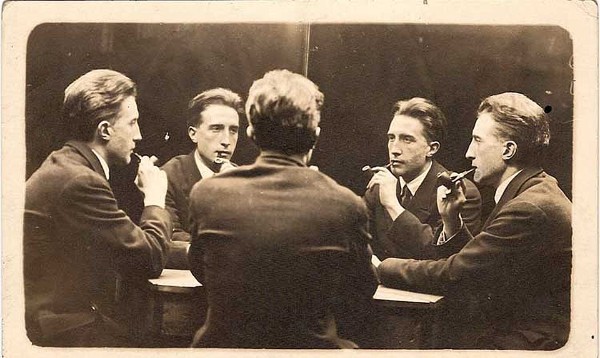
Five-Way Portrait of Marcel Duchamp, 21 June 1917 (National Portrait Gallery)
Although we regard it as pure Cubism and a rare example of Cubism showing motion, the Cubists thought it was too Futurist. Nonetheless, it was exhibited in Barcelona at a Cubist exhibition in 1912 and then was shown in the 1913 Armory Show in New York City, where it was ridiculed.
There are two versions, the first, painted in 1911, is smaller (95.9 × 60.3 cm (37 3/4 × 23 3/4 inches)) and was painted in oil on cardboard.
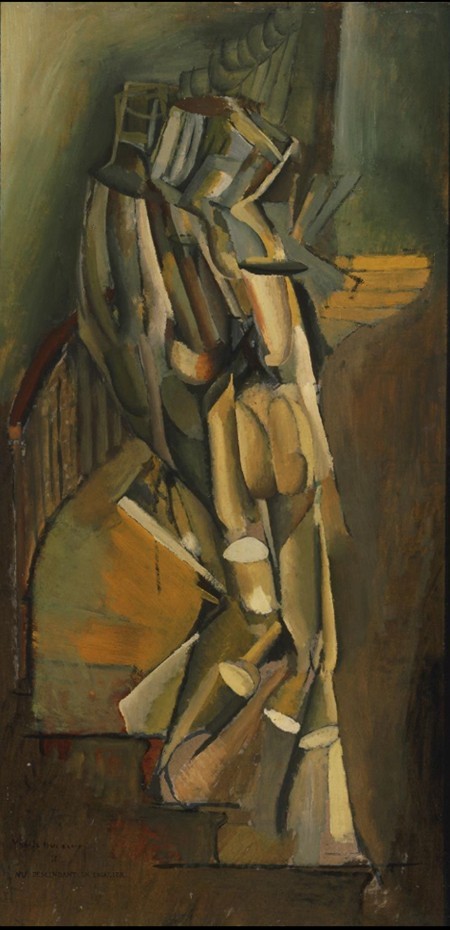
Marcel Duchamp: Nu descendant un escalier n° 1, 1911 (Philadelphia Museum of Art)
The second version painting is larger (147 cm × 89.2 cm (57+7⁄8 in × 35+1⁄8 in)) and was painted on canvas. Done in the colours of Cubism, browns and ochres, shows a figure, rendered in conical and cylindrical forms in downward motion. The viewpoint has been shifted so that we no longer see the stair-rail, the body form has multiplied, and the stairs are less clearly defined.
Rhythm and motion in the figure’s movement and dark edges define the body. At the bottom left, darkness indicates the staircase, and a matching section in the upper right is open space. In the middle of the right-hand side is a round object that looks like a newel post, defining the bottom of the stairs. The title of the work, in a lighter yellow, is written on the bottom left side.
It was Duchamp’s contention at the time of the 1913 Armory Show that it wasn’t the image itself that provoked controversy, it was the idea of the image: ‘What contributed to the interest provoked by the canvas was its title. One just doesn’t do a nude woman coming down the stairs … it seemed scandalous.’
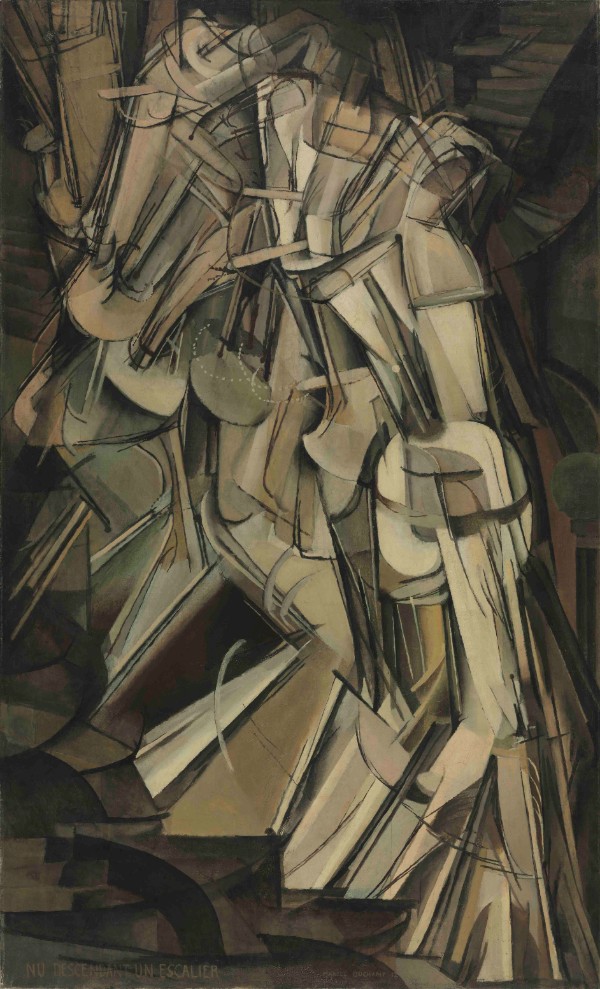
Marcel Duchamp: Nu descendant un escalier n° 2, 1912 (Philadelphia Museum of Art)
The influence of photographers such as Étienne-Jules Marey and Eadweard Muybridge’s ‘chronophotography’, where human and animal actions were photographed with a strobe camera to show the motion step by step. Muybridge’s photos were famous for proving that a running horse lifts all feet off the ground while running, something that was not perceivable until the photographs. Another outcome of the horse photographs was to show that a running horse was much less graceful than thought (or was usually depicted)!
Duchamp, with three artistic siblings, brothers Jacques Villon, Raymond Duchamp-Villon, and sister Suzanne Duchamp-Crotti, was involved in everything to do with the new developments in artistic style in the early 20th century. The poet Guillaume Apollinaire thought Duchamp’s nudes were very ugly. He submitted the work to the Cubist Salon des Indépendants in 1912, but after both his brothers came to ask him to either withdraw the painting or paint over the title in the bottom left corner, a request of the painter Albert Gleizes, Duchamp not only refused, but removed the painting from the exhibition entirely. One objection to the painting at this time, in addition to the confusion between it being Cubist or Futurist, was that its title was ‘too literary’.
The scandal at the 1913 Armory Show, which was the first major exhibition in America of the new artistic trends in Paris, was based on the fact that the American audience was used to much more realistic art than they were seeing. Fauvism, Cubism, and Futurism were all on exhibition, and the local audience didn’t like it. After the ‘normalcy’ of Impressionism, the wildness of the new styles was difficult for the American audience, and it was a difficult step for them to make.
Duchamp went on to scandalise even more audiences with his contribution to the Society of Independent Artists exhibit in 1917. His Fountain, a porcelain urinal signed ‘R. Mutt’ was not exhibited at the show, being there but hidden from view, and was eventually lost, although not before being photographed by Alfred Stieglitz in his studio. The Society couldn’t reject the piece, because they had agreed to exhibit everything for which the fee had been paid. Fountain was part of his Readymade series, which he explained as ‘everyday objects raised to the dignity of a work of art by the artist’s act of choice’. In the 1950s and 1960s, following the loss of the sculpture, 16 replicas were commissioned from Duchamp and created.
In 2008, Italian composer Vittorio Montalti wrote his own Nu descendant un escalier for clarinet, violin, cello, percussion, and piano.
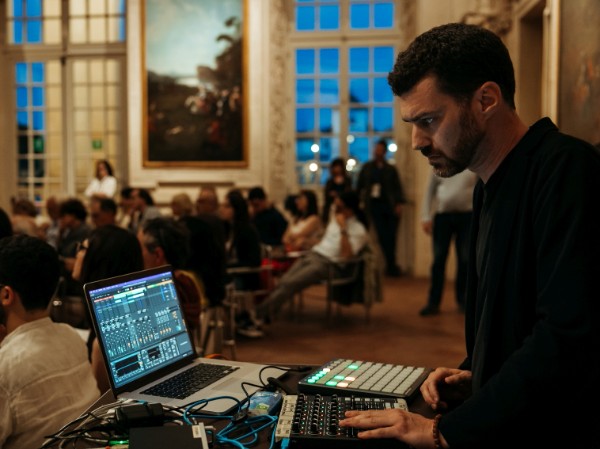
Vittorio Montalti
Using Duchamp’s idea of creating a ‘static representation of motion’, Montalti constructed his work on a similar idea in music: ‘by constructing in the first part of the piece an “object” that is both rising and falling, superimposing the rising direction of the chords and the figurations of the vibraphone … and of the piano …and the falling movement, much faster, of the violin and cello parts …’.
Both the vibraphone and the piano are ‘prepared’, the vibraphone with paper handkerchiefs to dampen some of the notes, and the piano with wooden pegs inserted in the strings. The clarinet and the violin just twitter in the background, with occasional places where they emerge out of the background.
Vittorio Montalti: Nu descendant un escalier (Divertimento Ensemble, Ensemble; Sandro Gorli, cond.)
It starts just as the painting does, in the middle of a motion – we seem to join it already in progress. The places where the clarinet emerges from the background sound are much like the details in the painting—much like in the painting where a form catches the light, such as the back of a leg in the middle of the image.
If Duchamp’s creations were difficult for his contemporary audience to understand, the Montalti set himself a considerable task in bringing them to music. In his setting, with each instrument occupied with a different kind of idea, Montalti is successful in creating Duchamp’s world of motion. There’s always something moving, always something catching us by surprise, rather like the elements of the picture just catching the corner of our eye. Montalti’s music also has sections of repose, when nothing seems to be moving—akin to the stop-motion photography that we know from Muybridge and which was such an example to Duchamp in the creation of this painting.
Duchamp challenged his viewers with this painting, and with so much of his other work, and Montalti matches that innovation.
For more of the best in classical music, sign up for our E-Newsletter