Inspirations Behind Stuart Greenbaum’s Mondrian Interiors
The Dutch painter Piet Mondrian (1872–1944) was one of the most influential artists of the 20th century. As a pioneer in abstract art, he made the important move from figurative painting through an increasingly abstract style to the point where simple geometry was his language.
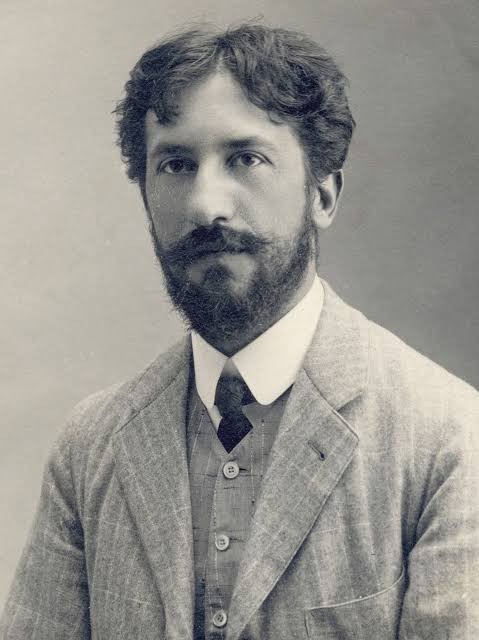
Piet Mondrian in his 30s (Ridinghouse and Kunstmuseum Den Haag / National Archives / Spaarnestad Collection)
In his work for harp and ensemble, Mondrian Interiors, Australian composer Stuart Greenbaum (b. 1966) takes us through Mondrian’s style from 1909 to 1942 and in traveling with him, we can appreciate in sound what Mondrian was achieving in art.
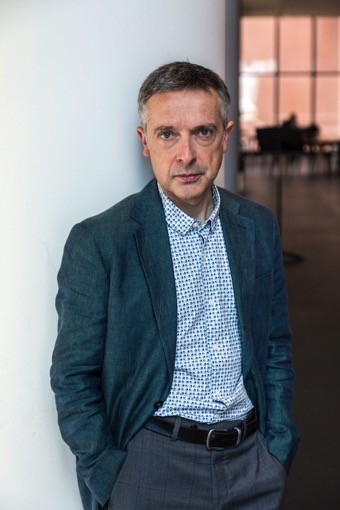
Stuart Greenbaum (photo by Pia Johnson)
One of Mondrian’s most important early works was his red tree. Mondrian started as a landscape painter, and in one of his last paintings of a tree, he started with sketches he’d done earlier in the Netherlands. There’s a lot of Impressionism in the work, as well as Fauvism, with the juxtaposition of patches and lines of colour. The tree’s setting is only implied, with what seems to be a fence behind it. This is the intense blue of the evening, which seems to darken as it gets caught in the complex centre of the wild tree.
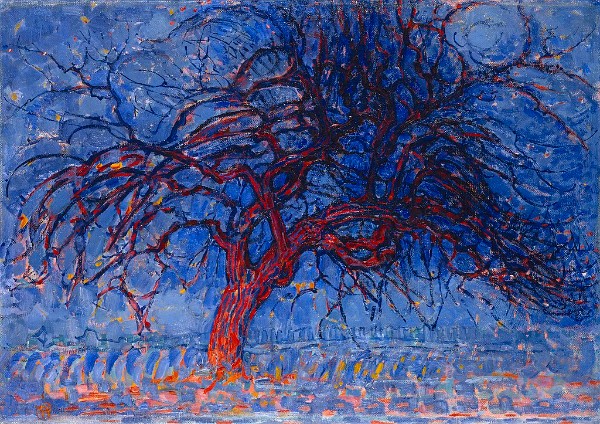
Piet Mondrian: Evening; Red Tree (Avond; De rode boom), 1908-10 (Gemeentemuseum Den Haag)
In his setting of the image, as it were, Greenbaum immediately takes us to the urgency in the red colouring against the intense blue sky. The harp soloist is immediately a contrast to the held chords of the ensemble, seeming to scrabble up the increasingly smaller and smaller branches, until sliding back down again, and repeating the return upward.
Stuart Greenbaum: Mondrian Interiors – I. The Red Tree (Jessica Fotinos, harp; ANAM (Australian National Academy of Music Musicians))
After he moved to Paris in 1912 (and changed his name from Mondriaan to Mondrian), the artist came under the influence of Cubism and reduced the tree to lines. The tree is lines of verticals and horizontals, with an occasional bend or angle to reflect the tree’s real growth. It forms an inverted pyramid, moving upward from the trunk to the expanding branches. The exposed branches and the lack of colour may lead us to suspect a winter or early spring scene. At this point, Mondrian said ‘‘I want to come as close as possible to the truth, and abstract everything from that until I reach the foundation of things”.
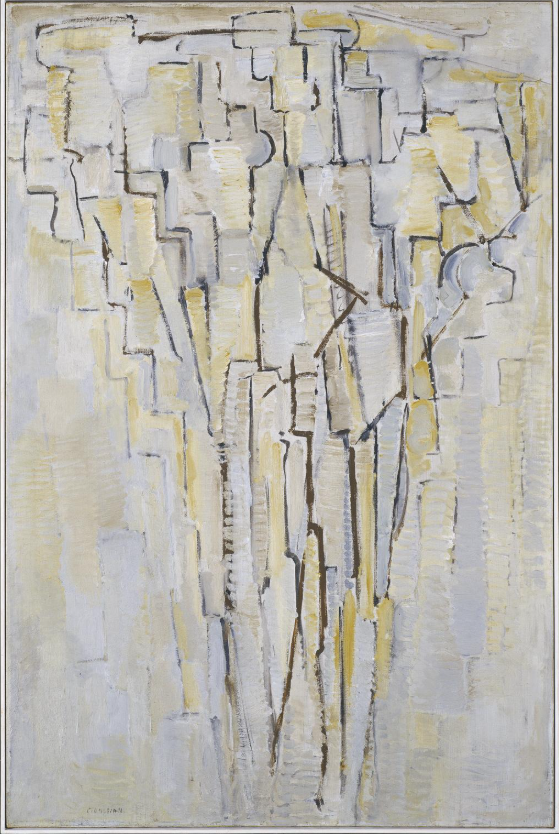
Piet Mondrian: The Tree A, ca 1913 (London: Tate Gallery)
The harp picks out the delicate lines of the branches while the piano supplies necessary support. It’s pensive and wistful, with the isolated piano notes setting the place from which the harp expands. The composer calls this a ‘cubist reduction’.
Stuart Greenbaum: Mondrian Interiors – II. Tree (Jessica Fotinos, harp; Aidan Boase, piano)
Mondrian’s sketch of the Johanneskere at Domburg carries weight, even in black and white. The mighty tower, with its supporting buttresses, makes the central door at the very bottom seem minuscule, but that is the measure of the people who enter the church. The tall steeple, the church clock, and the cross are cut off in this image. Mondrian has also simplified the image, removing a round tower from the right side.
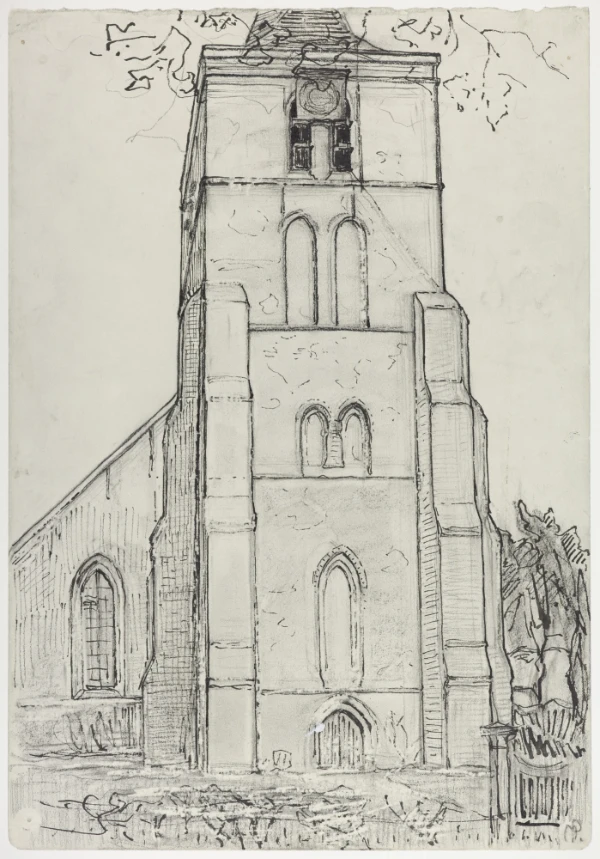
Piet Mondrian: Church at Domburg, ca 1914 (Kunsmuseum Den Haag)
In the photograph of the church, taken from a distance, the change in perspective and the addition of the tower make the building seem lighter than Mondrian’s heavily angled view.
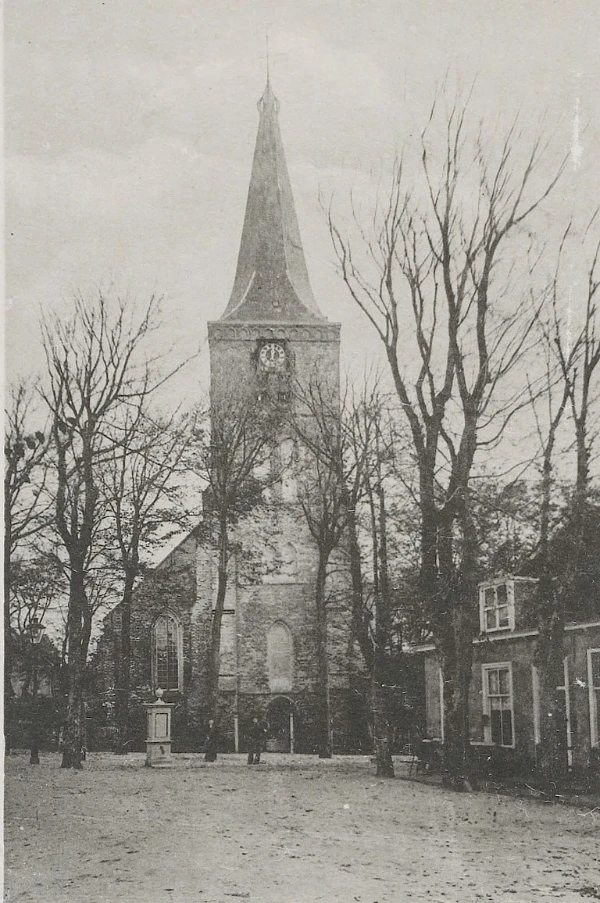
Church Tower at Domburg
Greenbaum based his work for solo harp on the black and white charcoal sketch, not the earlier colour paintings.
Stuart Greenbaum: Mondrian Interiors – III. Church at Domburg (Jessica Fotinos, harp)
In Paris, Mondrian painted the world around him, in this case, the demolished buildings that still bore the evidence of the life that had been in them.
This new style for Mondrian, which would become the basis for his art to the end of his life, he named ‘Neoplasticism’, as a kind of Abstractionism. Neoplasticism sought to ‘express a new utopian aesthetic of harmony and order’.
In his painting, Mondrian shows us the exposed floors, chimneys, and the patches of wallpaper that remained. In reducing them to vertical and horizontal lines, with the occasional curve, he believed that he was expressing an underlying universal order. By making this an oval, he makes it seem like we’re looking at this from the interior of another building. He was still developing his style; whereas mature Neoplaticism in its final form would have all colour bounded in black, we can see at the top that juxtaposed colours were still permitted.
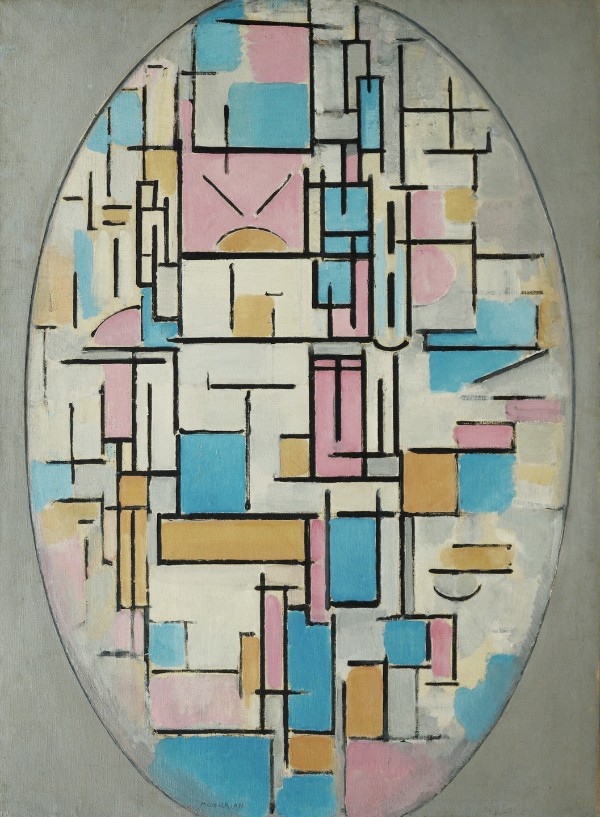
Mondrian: Composition in Oval with Colour Planes I, 1914 (New York: Museum of Modern Art)
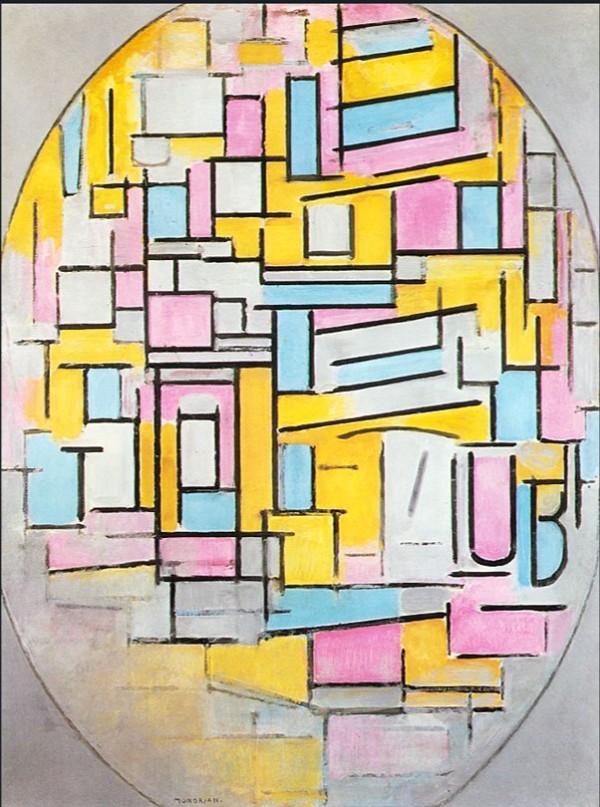
Mondrian: Composition in Oval with Colour Planes II, 1914 (Gemeentemuseum Den Haag)
As a contrast with the previous black and white sketch, Composition in Oval with Colour Planes fills in the colour, and Greenbaum uses the full ensemble, each voice providing its individual timbre and motion.
Stuart Greenbaum: Mondrian Interiors – IV. Oval with Color Planes (Jessica Fotinos, harp; ANAM (Australian National Academy of Music Musicians))
Mondrian’s two 1919 paintings of a checkerboard, one in light colours and the other in dark colours, were part of his ongoing experiments with both geometrical division of form and experiments with colour. His unconnected lines become a 16×16 rectangle subdivided equally, with equal distribution of each colour. The same colour may be juxtaposed on neighbouring squares, but the division between them remains clear. The viewer starts to see a rhythmic progression that has been likened to ‘a musical rhythm flowing over the bar-lines’. Mondriaan wrote in 1919 that ‘finally, the artist no longer needs a specific natural phenomenon to arrive at an image of beauty.’
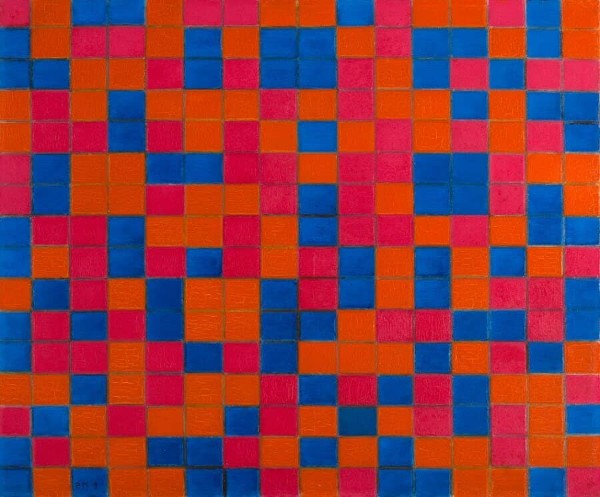
Mondrian: Composition Chequerboard, Dark Colours, 1919 (Kunstmuseum Den Haag)
The full ensemble plays in this movement, with a rhythmic drive in the instruments pushing almost as a wind, moving the work forward. There’s much repetition, as there is in the painting, but the change in which instruments are played together changes how we hear their importance. Mondrian described his work as a ‘reconstruction of a starry night’, and Greenbaum sees his music as a ‘definite move towards what I see and hear as Minimalism’.
Stuart Greenbaum: Mondrian Interiors – V. Chequerboard, Dark Colours (ANAM (Australian National Academy of Music Musicians))
In his quest for art to express deeper truths about the world, rather than just portray what was on the surface, Mondrian published his essay on Neo-Plasticism. The first painting that followed that public statement was his 1921 Composition with Large Red Plane, Yellow, Black, Grey and Blue. All recognisable physical objects are swept away and represented by black-defined spaces. In his painting, Mondrian was careful even to eliminate his brushstrokes.
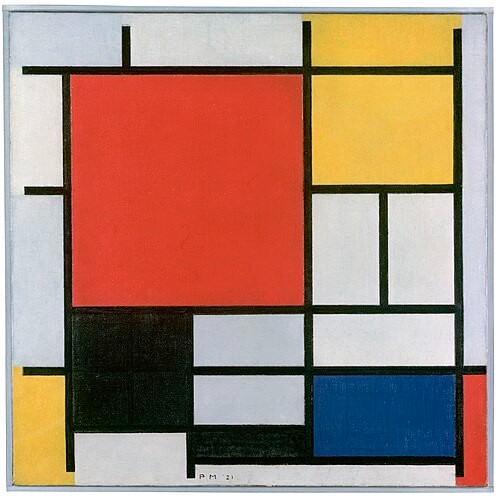
Piet Mondrian: Composition with large red plane, yellow, black, gray and blue, 1921 (Gemeentemuseum Den Haag)
In setting music to Mondrian’s first steps in what would become his mature style, Greenbaum uses oboe, bassoon, and harp to create a trio with space, both defined by expansive lines and silences.
Stuart Greenbaum: Mondrian Interiors – VI. Red, Yellow and Blue (David Reichelt, oboe; Christopher Haycroft, bassoon; Jessica Fotinos, harp)
A doubly atypical painting by Mondrian is his 1933 lozenge painting, Composition with Yellow Lines. It only uses one of the colours of his usual palette (yellow instead of yellow, red, and blue within black lines), and it is not oblong or square but turned into a diamond. The two paintings in this style are called his ‘lozenge’ paintings, in part to ensure that they are hung correctly. The work is also unusual in that the lines do not meet on the canvas, but somewhere out in the space beyond.
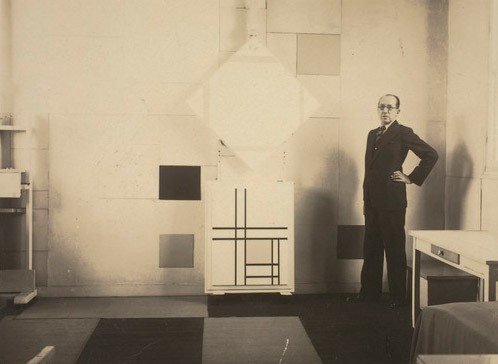
Mondrian in his Paris studio with Composition with Yellow Lines, 1933
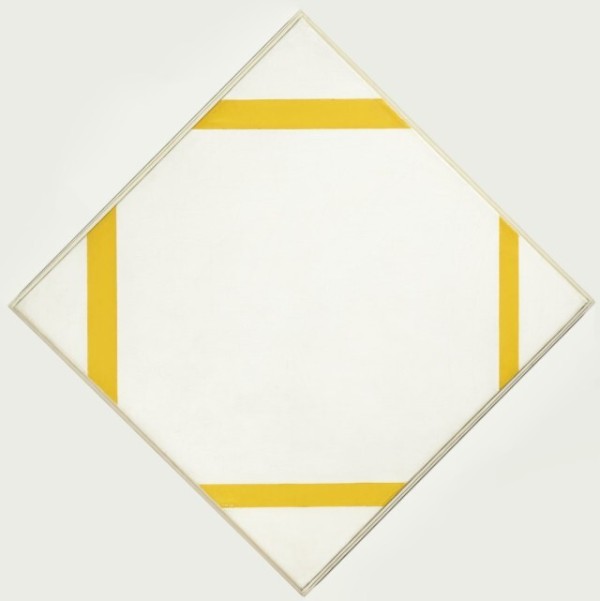
Piet Mondrian: Composition with Yellow Lines, 1933 (Gemeentemuseum Den Haag)
The two colours of Mondrian’s work, the off-white background and the yellow lines, are given to the clarinet and piano duo.
Stuart Greenbaum: Mondrian Interiors – VII. Yellow Lines (Paul Dean, clarinet; Aidan Boase, piano)
The last work in our chronological tour of Mondrian’s work is his Composition with Red, Yellow and Blue. This is Mondrian’s mature style, where he achieved what he’d been working towards since 1914. All curves are gone; all subject matter suppressed. Using only horizontal and vertical straight lines, firmly expressed in black, and only primary colours, Mondrian reached towards expressing the greater universal truth beyond the surface. There is much in Mondrian that’s akin to the designs of another artist devoted to horizontal and vertical lines: Frank Lloyd Wright.
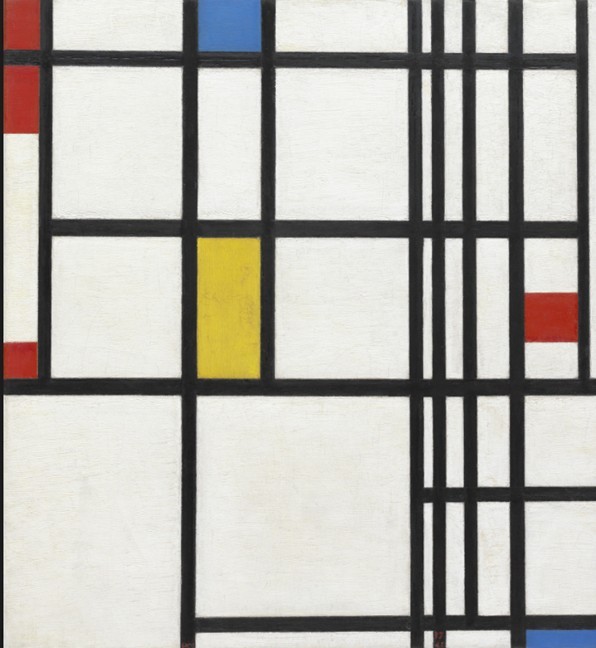
Mondrian: Composition in Red, Blue, and Yellow, 1937–42 (New York: Museum of Modern Art)
By giving his sixth and eighth movements the same name, Greenbaum takes the opportunity to move from a wind and harp trio to the full ensemble. He’s added what Mondrian does to its viewers – makes the surface move and carry us away.
Stuart Greenbaum: Mondrian Interiors – VIII. Red, Yellow and Blue (Jessica Fotinos, harp; ANAM (Australian National Academy of Music Musicians))
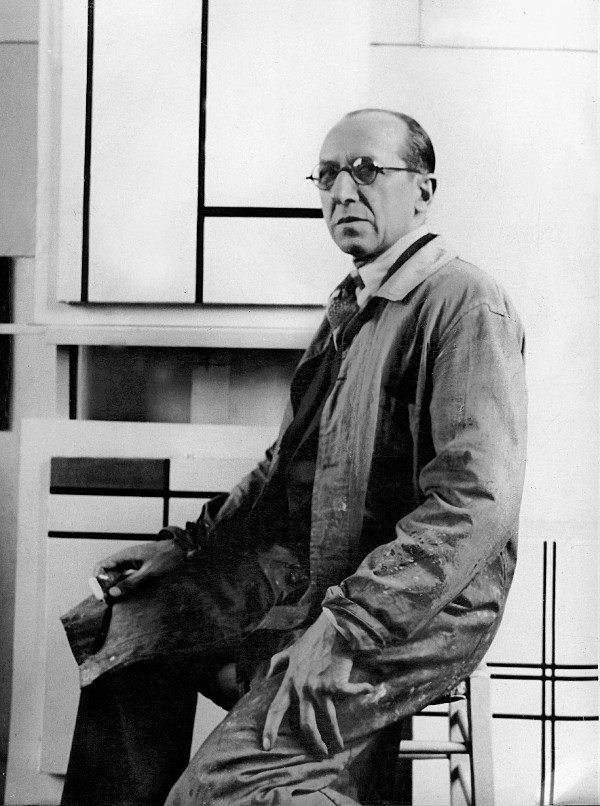
PIet Mondrian late in life
Mondrian’s ability to create a world that should be sterile and defined by its lines is, instead, a world of motion, of asymmetrical presentation, of a style beyond Abstraction that appeals to the eye, and in Greenbaum’s case, the ear as well. There is a grid in Mondrian’s final style, and he regarded the black lines as intrinsically important, but there is also motion in his use of colour. Our eye travels from colour to colour, and we feel as though it’s all moving. In this painting, unlike his earlier works, brushstrokes are important. The black stripes are all painted in the same direction, whereas the white sections are painted in layers, with each layer defined by brush strokes in different directions. This is the kind of micro detail that can only be seen face-to-face with the actual painting; it vanishes on reproductions and photographs.
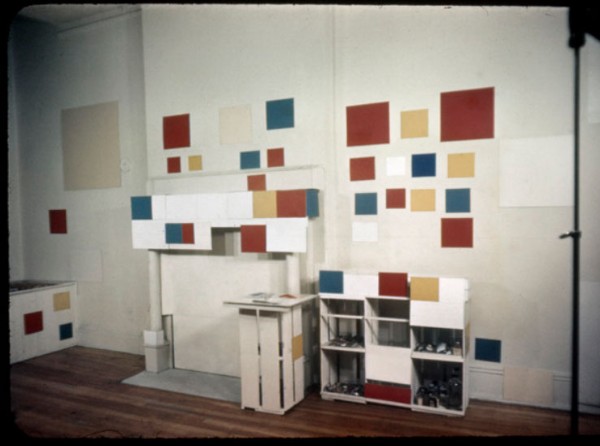
Harry Holtzman: The studio of Piet Mondrian after his death
Beyond art, Mondrian influenced design of all kinds, including Yves Saint Laurent’s 1965 tribute to the artist in his cocktail dresses. YSL made the dress and, in doing so, made the paintings animated. A two-dimensional painting becomes a three-dimensional piece of clothing, and the art is set off to walk in public.
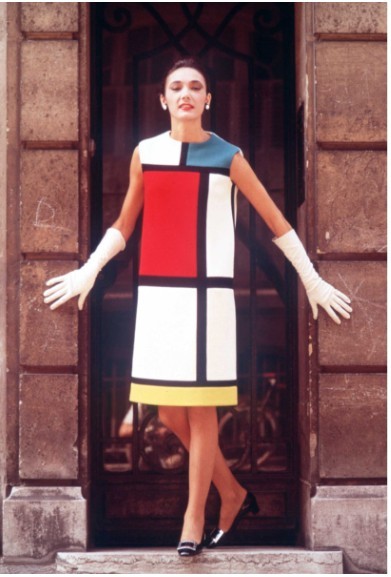
Muriel in a Mondrian cocktail dress, YSL for his AW 1965 collection (photo by Louis Dalmas)
By taking Mondrian’s paintings in chronological order and working through the artist’s developing sense of the Neo-Plasticism style, Greenbaum is able to use the variety of forces of his ensemble: harp, oboe, clarinet, horn, basso, and piano, to create his own colour palette in sound. Greenbaum was at the Tate Gallery in London in 1997 and saw a special exhibition of the works of Mondrian there. He bought a set of postcards of the works he liked with the intent of setting them to music. In 2007, he took up the idea of Mondrian’s work again. The work is dedicated to Marshall McGuire and Southern Cross Soloists, who commissioned the work with assistance from the Music Board of the Australia Council for the Arts.
For more of the best in classical music, sign up for our E-Newsletter