Inspirations Behind Edward Gregson’s Le Jardin à Giverny
In 1964, while a student at the Royal Academy of Music, British composer Edward Gregson composed a Romance for clarinet and piano, written for Robert Hill, then a fellow-student and later principal clarinet of the London Philharmonic Orchestra. In 2016, he looked back on the work and rewrote it, with substantial revision, for Alison Teale, to be performed by cor anglais and string quartet.

Edward Gregson
By taking a work he’d first written at age 19 and revisiting it some 50 years later, he was able to take the student work to new harmonic places. His student work was filled with flowing chromatic harmonies, but it took his 50 years of expertise to bring it to its fullest definition.
Its colouring reminded Gregson of a painting by Claude Monet (1840–1926). Monet’s late works were all done in his own garden at Giverny, and so Gregson named the new piece for one of Monet’s paintings of his garden from 1900, Le Jardin de l’artiste à Giverny, shortened to merely Le Jardin à Giverny.
Edward Gregson: Le Jardin à Giverny (version for cor anglais and string quartet) (Alison Teale, cor anglais; Navarra Quartet, Ensemble)
In Gregson’s music for the garden, there’s a certain loneliness in the cor anglais’ declarations, with the string quartet both supporting and echoing its lines. We wander through a world of colour, stopping to view this plot and that plot. The wind catches the flowers, tossing them in the breeze and creating new patterns.
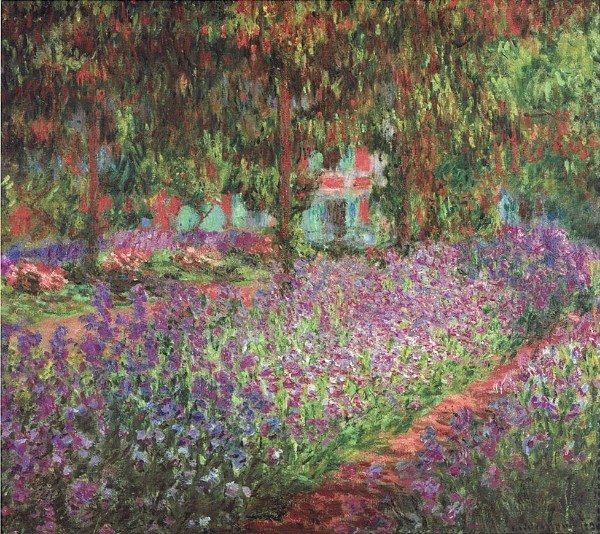
Monet: Le Jardin de l’artiste à Giverny, 1900 (Paris: Musée d’Orsay)
Monet is looking diagonally across his garden and at the many rows of irises that have sprung up, presenting their purple flags to the sun. Monet’s tastes in the garden were well known – he had a garden dominated by perennials that returned every year, with a few single-appearing annuals as highlights. He hated bare earth and loved the colour blue. He hated single flowers and loved doubled ones. The foliage should be green and not variegated. With those desires and rules in place, he created a garden that even a century later still holds its fame as a place to visit and experience.
For a painter in the impressionist style, a garden must be one of the most difficult subjects. The theory of juxtaposed colours of impressionism is met at its maximum in a garden such as Monet’s.
This miniature gives us many ways of looking at Monet’s world – both from the surface of pure colour and from the reflection and memory that the garden, and all those that preceded it, bring to mind.
For more of the best in classical music, sign up for our E-Newsletter