Inspirations Behind George Antheil’s McKonkey’s Ferry
The American Revolution (1765–1783) started as an ideological and political movement until it became a full-blown war against the British. The war started on 19 April 1775 in the Province of Massachusetts Bay, with the battles at Lexington and Concord. Two months earlier, the British government had declared Massachusetts to be in a state of rebellion and was moving troops to capture reported arms depots in Concord. The news had already been discovered by the Americans, and they had moved the arms to safety. The famous ride of Paul Revere to warn about the arrival of the British Army by water (with lights in a church tower communicating ‘one if by land, two if by sea’) came the night before the battle. In the first battle, the Americans fell back, but later in the day, at North Bridge in Concord, the Americans forced the British to retreat.
By December 1776, the Americans, now formed into the Continental Army under General George Washington, had driven the British out of Boston (where they had retreated after the Concord battle), but the British had captured New York City. Washington made a surprise winter crossing of the Delaware River to defeat the British at Trenton and Princeton.
Washington’s crossing was memorably painted by German painter Emanuel Leutze in 1851, 75 years after the event.
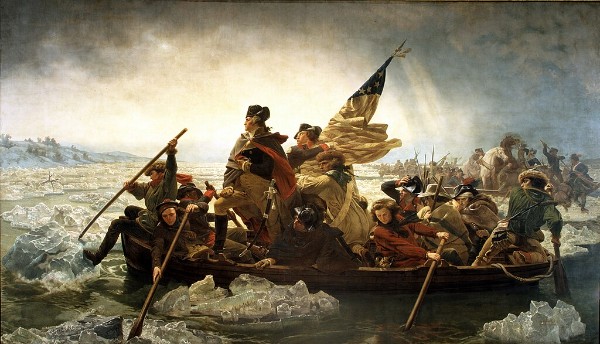
Emanuel Leutze: Washington Crossing the Delaware, 1851 (Metropolitan Museum)
1776 had not been a good year for Washington. He had been defeated several times and showed no major victories. One battle on Long Island, New York, resulted in a retreat to New Jersey, leaving New York City in the hands of the British. In addition, the enlistments of many of the soldiers would cease on New Year’s Eve 1776, and Washington would be left without an army. He needed a victory to not only revitalise his army’s spirit (and give them a reason to re-enlist) but to do the same for the idea of the Revolution.
Plans were made for a crossing on the night of 25 December, with the hope that the British troops would be busy celebrating the holiday and not keeping watch. Washington gathered his troops, and then a terrible storm arose – the roads were clogged with mud, and the river was running with ice. At midnight, the crossing was delayed to 3 am and launched. Although the British commander suspected an attack and his army slept in their clothes, the storm provided cover for Washington, and the attack was successful. The British lost 1100 men to capture, 22 dead, and 83 wounded; the Americans had 2 dead and 5 wounded. As Washington hoped, the victories brought re-enlistments and new enlistments, and the war was back on track.
Leutze, who had lived in the United States as a child, spent his adult life in Germany. Applying the story of the American Revolutionary War to the 1848 uprisings in Germany and then throughout Europe, he created the work to inspire the European reformers. He wanted them to look at the American Revolution as an example of a revolution that succeeded. The first painting was damaged in a fire, and Leutze painted a second one in 1851. This one was taken to the US for exhibition, and people came from all over the country to New York City to see the work.
The painting is enormous (378.5 cm × 647.7 cm (149 in × 255 in)) and was designed to impress. The copy at the Metropolitan Museum is a contemporary full-sized replica of the original, which was in the Kunsthalle Bremen until it was destroyed during WWII.
The American composer George Antheil (1900–1959) was known as the ‘Bad Boy of Music’ and brought avant-garde ideas to music, such as exploring sounds from industry as part of music, as seen in his Ballet Méchanique of the mid-1920s.
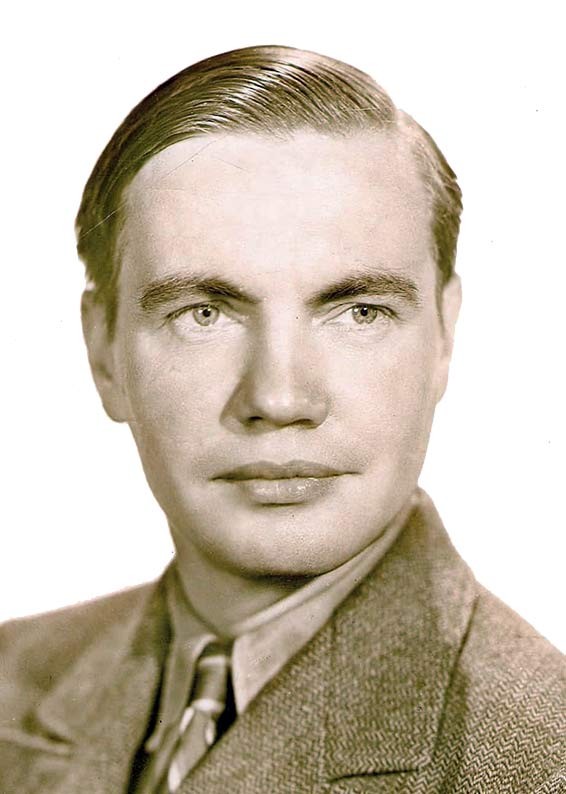
George Antheil
In the late 1940s, Antheil wrote music based on American themes, such as the American Dance Suite No. 1 (1948) and Tom Sawyer (1949). These short movements included McKonkey’s Ferry (1948). Washington’s crossing of the Delaware River departed from McConkey’s Ferry in Pennsylvania.
Antheil starts with a dramatic statement, underlined by the percussion. Its steady pace could illustrate the progression of Washington’s Army over the poor and muddy roads to the riverside. There’s a driving idea that persists in moving everything forward. Danger is all around, but the sense of missing still drives forward as the music grows in intensity.
George Antheil: McKonkey’s Ferry (Washington at Trenton) (Ukraine National Symphony Orchestra; Theodore Kuchar, cond.)
Antheil’s music captures the drama and the emotion of Washington’s Army and its desperate attempt to keep the Revolution alive. Even as a post-war piece, Antheil’s work can stand on its own and not live under the cover of patriotism: he took a dramatic scene and created the music that was appropriate for it. As we look at the painting, we see the belief and optimism with which Leutze imbued it. We can tell from the heroic postures that success is in Washington’s future. In Antheil’s piece, however, he doesn’t tell us the happy ending, but brings us music full of tension and drama.
For more of the best in classical music, sign up for our E-Newsletter