Adam Schoenberg’s Finding Rothko Inspired by Mark Rothko’s color-field paintings
Faced with a commission by the IRIS orchestra, American composer Adam Schoenberg (b. 1980) sought inspiration in the museums of Manhattan. He started with the Museum of Modern Art and found some paintings by American abstract painter Mark Rothko (1903–1970). His strong and very personal reactions to the paintings made him decide that Rothko would be the inspiration behind his commissioned work. Accordingly, he sought out the paintings that formed Rothko’s catalogue and chose four, both for their distinctiveness and their similarities.

Adam Schoenberg
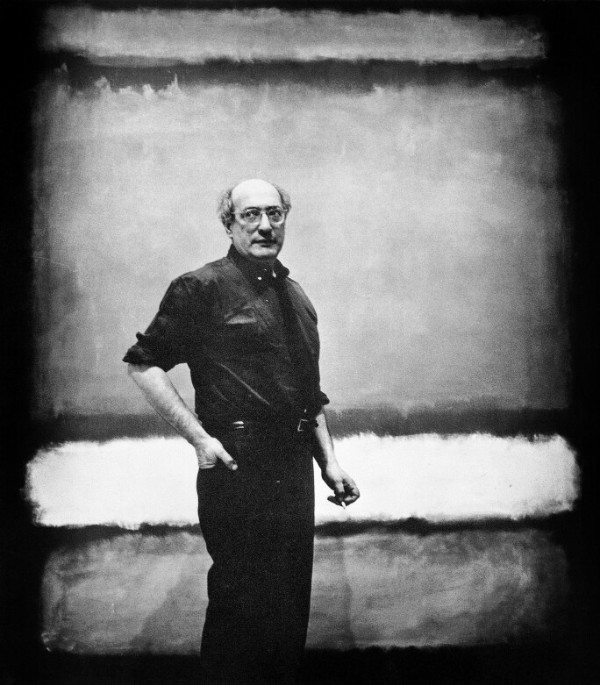
Mark Rothko
Schoenberg’s four movements are named for colours: Orange, Yellow, Red, Wine, which are not the names of the paintings.
The Orange movement is based on a painting at the Guggenheim Museum in New York: Violet, Black, Orange, Yellow on White and Red, but which is otherwise untitled. This work dates from 1949.
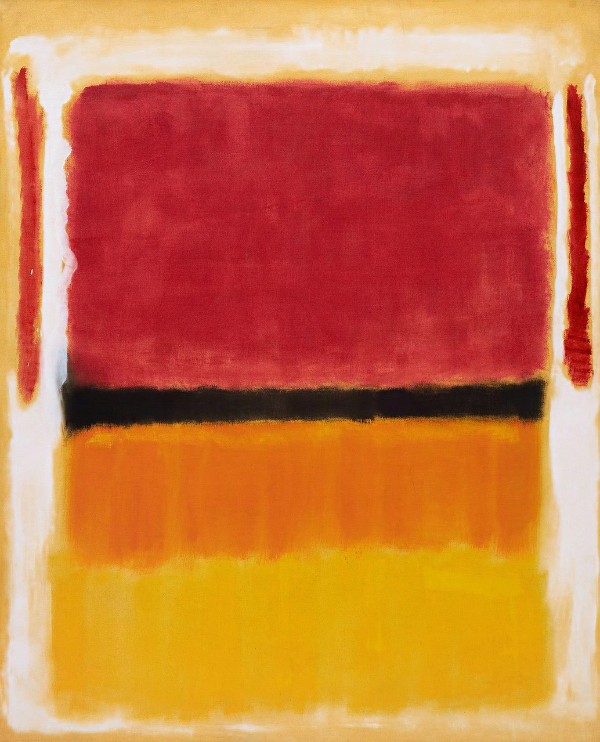
Rothko: Violet, Black, Orange, Yellow on White and Red, 1949 (New York: Guggenheim Museum)
By 1949, Rothko was in his mature style that he would follow for the next 20 years: stacked rectangular fields made of luminous colours. These were his way of expressing universal human emotions through works of ‘awe-inspiring intensity’.
Some critics see these paintings as the equivalent of both Romantic landscapes and religious works. The work has the size and proportion of traditional altarpieces, and ‘the stacked rectangles may be read vertically as an abstracted Virgin bisected by horizontal divisions that indicate the supine Christ’ (Chave).
In his music, the composer wanted to preserve the individualities of each painting, yet shows the core continuity via the ‘Rothko theme’ that precedes each section (the work is to be played without pauses between movements). Schoenberg is also pulling out elements of each picture, as we will see below.
Adam Schoenberg: Finding Rothko – Orange (Kansas City Symphony; Michael Stern, cond.)
A work from 1950, entitled No. 5 / No. 22, comes from 1950, although it is dated 1949 on the back of the painting.
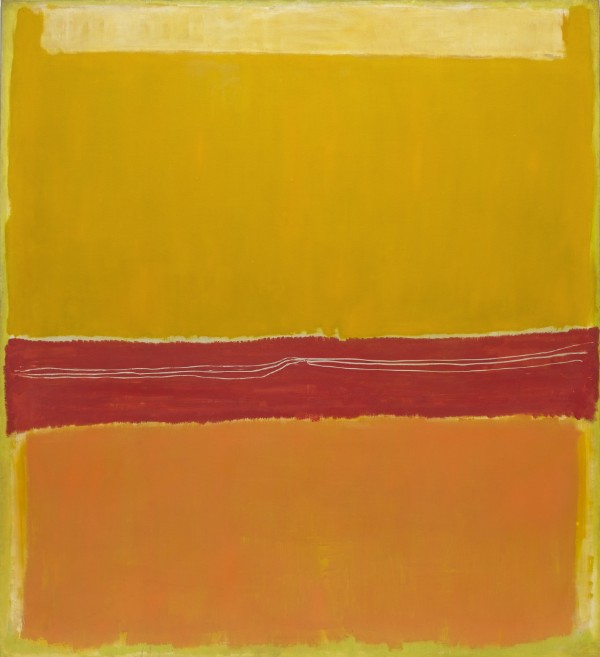
Rothko: No. 5 / No. 22, 1950 (dated 1949 on reverse) (New York: Museum of Modern Art)
The rectangles on this painting are contained within the canvas, not extending to the edges, and so seem to hover. In addition, through his choice of colours is the effect of ‘chromatic aftertimage’. ‘Staring at each colored segment individually affects the perception of those adjacent to it. The red–orange center of the painting tints the yellow above it with just a bit of green. The yellow above seems to tint the orange with blue’.
Despite these colour qualities, what Rothko wished the viewer to come away with is not the colour relationships but said, ‘I’m interested in expressing the big emotions—tragedy, ecstasy, doom’.
Adam Schoenberg: Finding Rothko – Yellow (Kansas City Symphony; Michael Stern, cond.)
The strip of red colour in the MoMA Painting led him to the next painting, No. 301, which also carries the description of Reds and Violet over Red/Red and Blue over Red.
![Rothko: No. 301 (Reds and Violet over Red/Red and Blue over Red) [Red and Blue over Red], 1959 (The Museum of Contemporary Art, Los Angeles, The Panza Collection)](https://interlude-cdn-blob-prod.azureedge.net/interlude-blob-storage-prod/2026/01/No.-301_processed.jpg)
Rothko: No. 301 (Reds and Violet over Red/Red and Blue over Red) [Red and Blue over Red], 1959 (The Museum of Contemporary Art, Los Angeles, The Panza Collection)
By pulling the horizontal blocks back from the edge, the colours again seem to float against a slightly lighter background colour.
The ‘enormity and brilliance’ of this painting convinced the composer that this work should be the climax of the composition.
Adam Schoenberg: Finding Rothko – Red (Kansas City Symphony; Michael Stern, cond.)
The final painting that Schoenberg found in Rothko’s catalogue took some work to track down, finally locating it in a small museum in Potomac, Maryland.
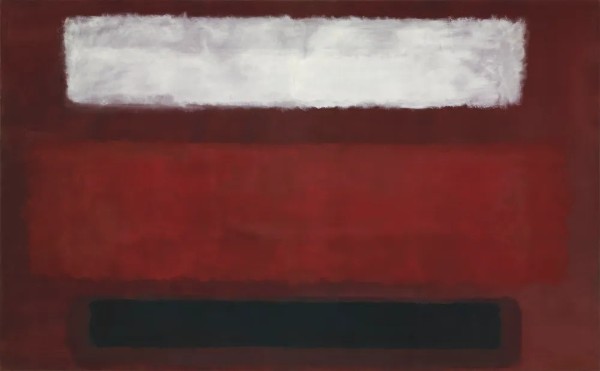
Rothko: No. 9 (White and Black on Wine), 1958 (Potomac, MD: Glenstone Museum)
The use of colour here is very different, with a cloud-like white and an unmoving black anchoring the top and bottom of the picture. Schoenberg saw this work as the culmination of the other paintings, finding it ‘incredibly haunting’. This movement takes the ‘Rothko’s theme’ that opened every movement to this point and develops it.
Adam Schoenberg: Finding Rothko – Wine (Kansas City Symphony; Michael Stern, cond.)
All four works come from Rothko’s mature style and are dated within 2 years of each other (1958 to 1959). One writer noted that ‘Often larger than a human being, Rothko’s canvases inspire the kind of wonder and reverence traditionally associated with monumental religious or landscape painting’. Rothko wants the viewer to look deeper into the art, and, by association, look into himself or herself to find the larger emotional message. Although this is called colour block painting, colour and blocks are the least part of the artist’s message.
Finding Rothko received its premiere on 13 January 2007 by the IRIS Orchestra, conducted by Michael Stern.
For more of the best in classical music, sign up for our E-Newsletter